
"The ISICL program is one of the very few places throughout health professions education intentionally set aside to talk not only about science and medicine, but also about what it means to become a leader and a team player along the way." — Erin Nicholas, third-year medical student and inaugural ISICL participant
For future healthcare professionals like Nicholas, technical expertise is only part of the equation. Delivering exceptional patient care also requires the ability to lead, collaborate across disciplines, and navigate complex team dynamics—skills that extend beyond what can be learned through classroom instruction alone. During the 2025–26 academic year, the Center for Interprofessional Practice and Education (CIPE) set out to change that by launching Interprofessional Students: Innovating. Collaborating. Leading. (ISICL), its inaugural student leadership development program designed to help students build those skills before entering practice.
ISICL emerged after CIPE, with student advice, identified a gap in formal opportunities for students to develop interprofessional leadership skills. Built around three guiding principles—innovation, collaboration, and leadership—the yearlong program was designed to help students develop leadership and change management skills through real-world projects while building lasting relationships across professions.
Hannah Edwards, CIPE Curriculum Manager and ISICL Program Director, believes those lessons are just as important as clinical knowledge. “When they go into these real areas, and they’re asked to do very real things, nobody teaches you how to have hard conversations with someone who might be four positions above you,” Edwards said. “Especially with students who are excited and want to go into leadership roles, teaching them those healthy habits of how to be a supportive leader, how to really help your team, and how it’s not about personal success, it’s about team success… That’s what’s really important.”
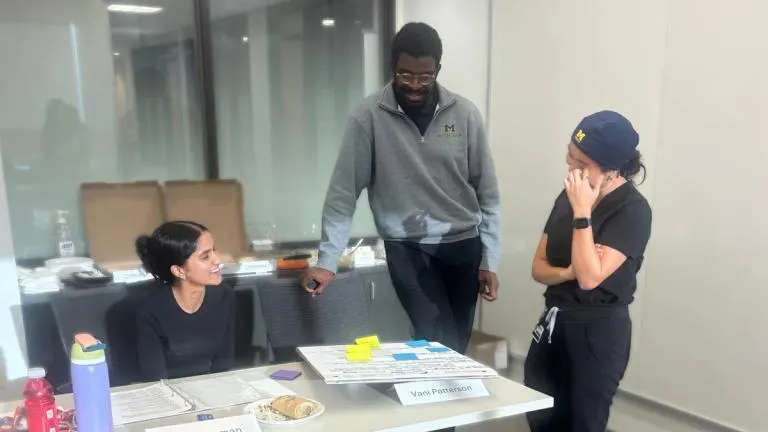
Rather than waiting until students entered the workforce, ISICL created a space where they could practice those skills alongside peers from different disciplines while tackling authentic healthcare challenges.
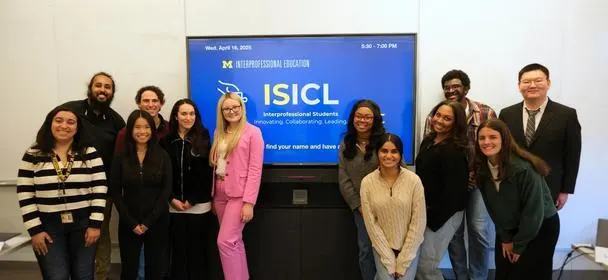
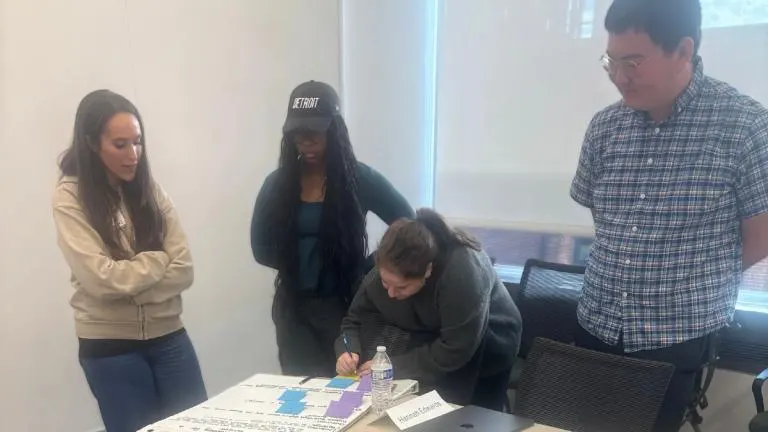
ISICL's inaugural cohort brought together 13 students representing seven University of Michigan schools. Working in interdisciplinary teams, students partnered with CIPE on projects addressing real challenges in healthcare education and patient care—from improving hospital discharge processes for individuals experiencing homelessness through Community-Based Participatory Research, to developing patient experience surveys and strengthening interprofessional debriefing models. Throughout the year, the cohort also met twice monthly for workshops centered on innovation, collaboration, and leadership.
U-M School of Social Work alumnus Jonathan Song joined ISICL after noticing few opportunities for meaningful interprofessional collaboration within his own research interests in mental health interventions. "I wanted to better understand how this field works while gaining the experience to become a future leader who can bring different health professionals together and be an agent of change," Song said.
Song was a part of the TEAMS debrief project, which focused on developing interprofessional debriefing models after experiential IPE in the curricular rotations. Through the project, Song saw firsthand the importance of interprofessional collaboration. Working alongside students from nursing, medicine, and other professions challenged Song to think beyond the perspectives common in social work. He gained new research approaches while becoming more confident sharing his own expertise, reinforcing his belief that effective collaboration comes from valuing every voice rather than relying on traditional hierarchies. He is preparing to share this work at the Nexus Summit this fall, hosted by the National Center for Interprofessional Practice and Education.
Across campus in the U-M Medical School, Erin Nicholas, a third-year medical student, also felt compelled to apply to ISICL after seeing its potential to bring together learners from different professions who were at similar stages in their careers. Nicholas worked on the Patient Experience Survey project, which created a survey that evaluated patient experiences with the LIFE (Longitudinal Interprofessional Family-based Experience) program. Through the project, Nicholas came to appreciate not only the diversity of professions represented on a team, but also the different perspectives and strengths each individual brings. She said effective collaboration depends on understanding those differences and creating an environment where everyone can contribute.
“At its core, working in healthcare is working with people. Whether they are patients or colleagues or administration, there are so many different roles that go into delivering patient care and creating a health system that positively impacts people,” said Nicholas. “It is very much not an individual sport, and you will not be able to impact the patient most effectively if you’re not working and collaborating with those around you.”
Although the inaugural cohort has completed the program, Edwards believes its greatest impact may be the confidence and sense of purpose students carry into their careers. Future iterations will place an even greater emphasis on student leadership in shaping the curriculum, ensuring the program continues to evolve alongside the needs of future health professionals. “Something I firmly believe is that if you're going to be teaching students, you need to have students’ input on what you're actually teaching, because you cannot do it for them without them,” Edwards said. “Any future iteration of ISICL should incorporate student voices.”
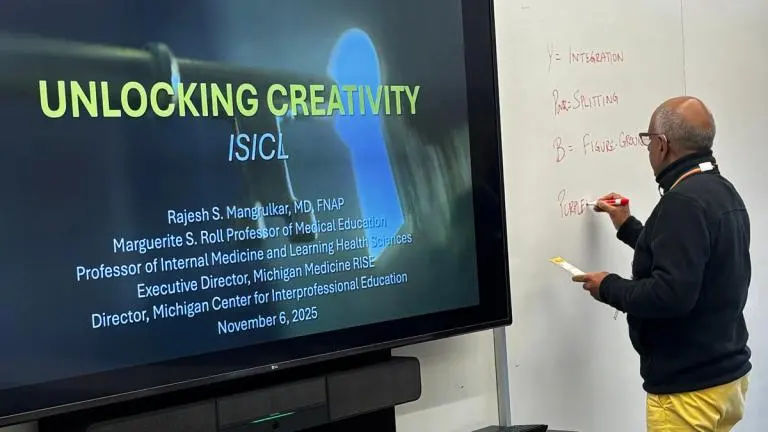
For Edwards, the program's impact became clear after one leadership session centered on Ikigai, the Japanese concept of discovering one's purpose. The next day, Edwards received an email from an ISICL student. “She had emailed me saying that she knew she wanted to be a physician, but it was always very hard for her to articulate exactly why she was actually called into this profession, and it wasn’t until the Ikigai session that she had that ‘Oh, this is why I do it’ moment,” Edwards said.
Months later, Edwards learned that the exercise had helped sustain that same student through some of the most difficult moments of medical school. "It's those moments where you realize the impact on your students," Edwards said. "This is why we do it."