
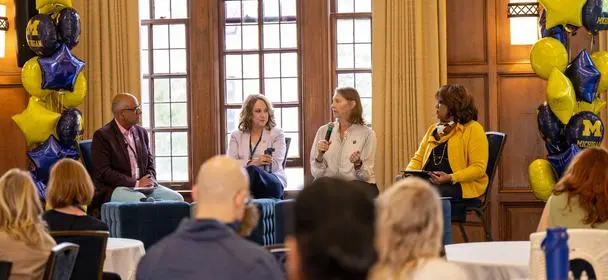
On April 13, a vibrant community of learners, educators, and practitioners from across Ann Arbor, Dearborn, Flint, and Michigan Medicine came together at the Michigan League for Health Professions Education (HPE) Connect ’26, continuing a long-standing effort at the University of Michigan to elevate health professions education across campuses and disciplines.
The reimagined conference builds on nearly three decades of momentum. What began as Medical Education Day expanded over time into Health Professions Education Day in 2015, led by the Department of Learning Health Sciences (DLHS) in partnership with the Center for Interprofessional Practice and Education (CIPE). The shift signaled a growing emphasis on shared learning across U-M’s health science schools.
After a year-long pause, HPE Connect ’26 marked a renewed approach to the conference, shaped by input from across the campuses through surveys and focus groups. Hosted jointly by CIPE and RISE (Research. Innovation. Scholarship. Education.), with continued sponsorship from DLHS, the conference brought together nearly 200 faculty, staff, and learners across the University’s three campuses and Michigan Medicine. Through presentations, demonstrations, and dialogue, a clear theme emerged: meaningful progress in improving health depends on learning and working together.
That theme was central to the day’s interactive leadership plenary panel, moderated by Rajesh Mangrulkar, director of CIPE and executive director of RISE. After sharing their own experiences and insights, the panel participants—all deans or vice deans of U-M schools and colleges—invited attendees to engage directly with them, surfacing shared challenges and exploring practical approaches to strengthening health professions education. The discussion emphasized the importance of participants seeing themselves as collaborators alongside leadership, reinforcing that lasting change cannot happen solely from the top down or bottom up, but must be shaped collectively.
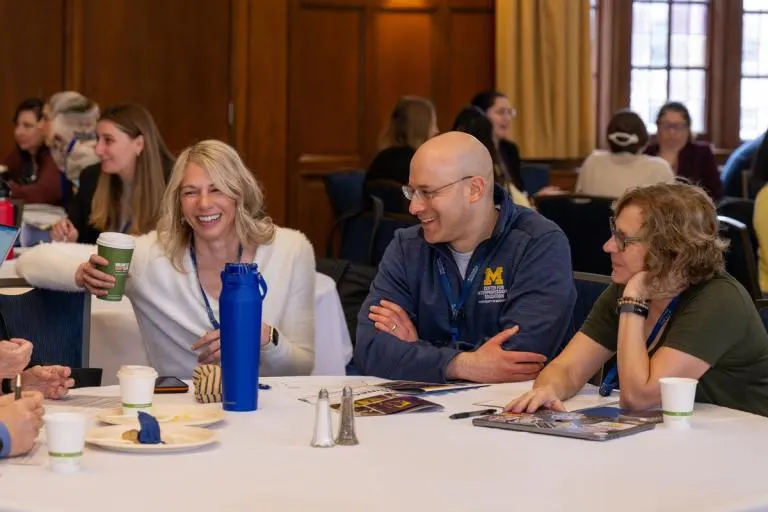
Caption: Small groups engage in discussion during the tabletop activity, exploring ways to advance collaboration in education.
Credit: Leisa Thompson, U-M Photography
The conversation also highlighted how expectations for health professions education are evolving. As Lou Edje, vice dean for medical education at the Medical School, noted, there is growing recognition at the national level of the importance of teamwork, adaptability, and innovation—signaling a shift toward educational models that better reflect the realities of modern health care.
That shift also calls for rethinking where and how collaboration happens. Vicki Ellingrod, dean of the College of Pharmacy, pointed to the need to expand the concept of teamwork beyond clinical settings and into the communities where health is shaped, expanding how learners engage with patients and communities.
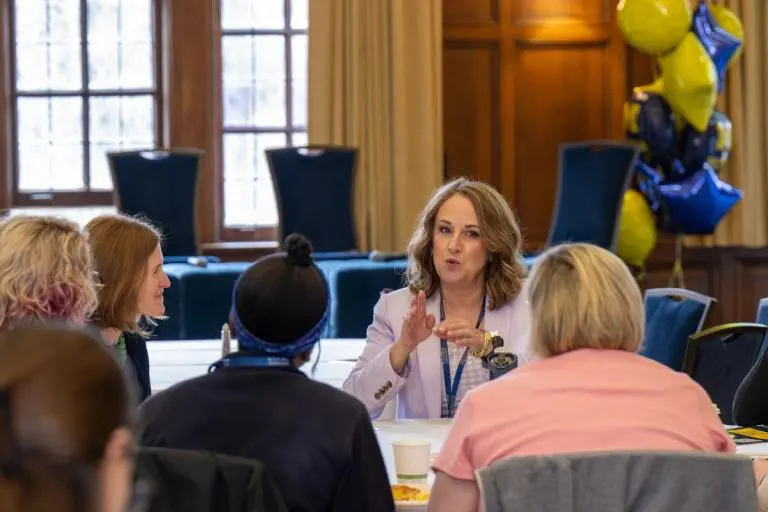
Caption: Elizabeth Birr Moje discusses solutions to support more collaboration in education with attendees during the tabletop activity.
Credit: Leisa Thompson, U-M Photography
Elizabeth Birr Moje, dean of the Marsal Family School of Education, extended that perspective further “upstream” to younger students, emphasizing the deep connections between health and learning and the need to account for how each influences the other. Preparing students, in this view, means not only equipping them with professional skills, but also understanding the broader conditions that shape both learning and health outcomes.
Together, their perspectives reinforced a shared call to move past traditional boundaries with intention and resilience, keeping both patients and learners at the center while advancing more connected, responsive approaches to education and health.
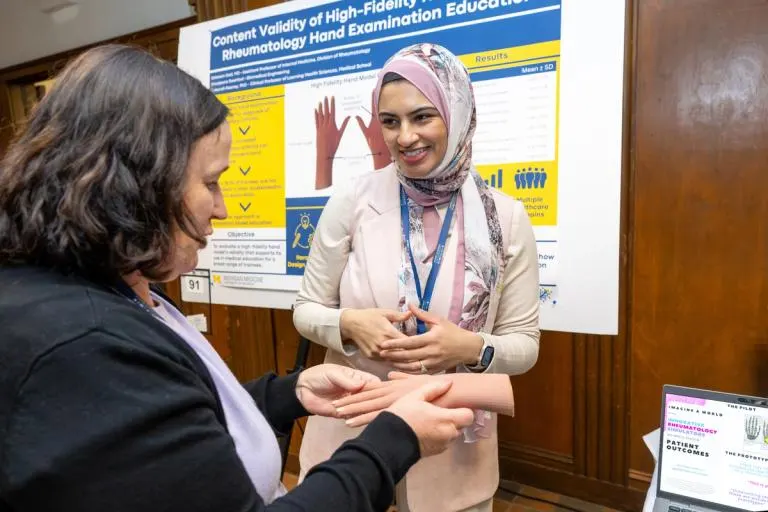
Caption: An attendee examines Ibtissam Gad’s (right) innovative hand model during the live demonstration and poster portion of the day.
Credit: Leisa Thompson, U-M Photography
Beyond the plenary, these themes carried into the rest of the conference. HPE Connect ’26 featured poster presentations and demonstrations that highlighted the breadth of educational innovation taking place across the University of Michigan. The conference also recognized excellence through lightning talks and awards. The IPE Awards honored Michelle Pardee, clinical associate professor in the School of Nursing, and Michele Bird, clinical assistant professor in Applied Exercise Science in the School of Kinesiology. The inaugural RISE Prize for Education Innovation recognized a street-based foot care initiative led by medical student-run teams, highlighting how experiential education can scale while delivering tangible impact. The initiative is led by students Ashley Park, Sanjana Paye, and their colleagues.
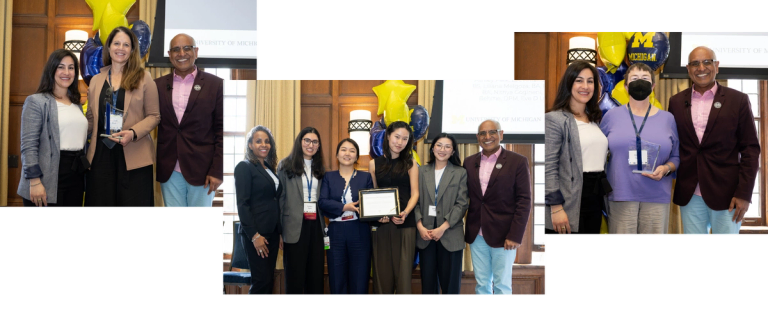
Caption: Recipients of the IPE Awards and the RISE Prize pose onstage.
Credit: Christina Merrill, U-M Photography
Reflecting on the energy of the day, Mangrulkar noted, “There is real momentum across the University of Michigan community, driven by teams willing to think creatively and work across disciplines and professions. When we bring diverse partners together, the work becomes more purposeful and effective. Just as importantly, we have to elevate voices that are too often left out of the conversation, especially learners, patients, and the communities we serve. That inclusion is what will shape a more responsive future for health professions education.”
HPE Connect ’26 reinforced a central idea that meaningful progress in health sciences and health professions depends on how we learn and work together. Across campuses, disciplines, and communities, the event reflected a growing commitment to strengthen that connection and ensure that education continues to drive better health.