
IPE Core Curriculum Offerings
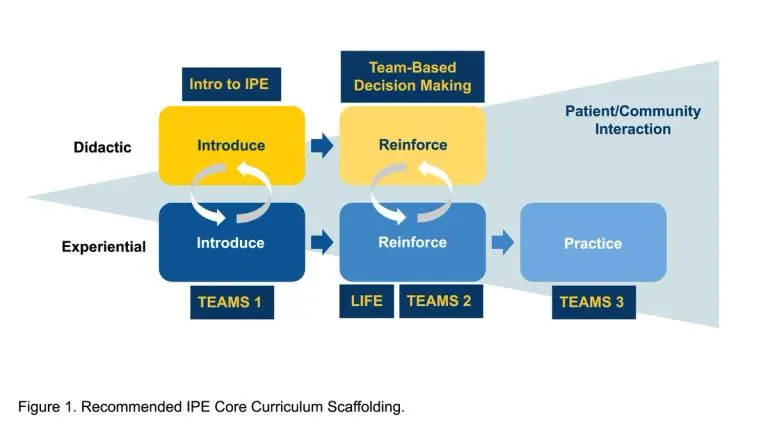
The IPE Core Curriculum includes six learning experiences designed to build interprofessional collaboration skills across the health sciences. Offerings range from introductory didactic learning to experiential, placement-based application.
How enrollment works: Most students are enrolled in IPE Core offerings through their health science program at U-M Ann Arbor, Dearborn, or Flint. Your home program will provide timing, deadlines, and submission instructions. Availability and requirements may vary by program. Students cannot independently enroll.
Introduction to Interprofessional Education (Intro to IPE)
Description: This course explores the principles and practices of interprofessional education (IPE) and collaboration, focusing on their role in achieving improved health outcomes and addressing the broader factors that influence health and well-being. Participants will examine the core competencies of effective interprofessional teamwork, analyze the dynamics of high-functioning teams, and develop insights into how personal and professional differences—such as conflict resolution styles, leadership approaches, and diverse identities—affect team interactions and patient-centered care. Through reflection and application, learners will deepen their understanding of how to foster collaborative environments that align with the quintuple aims of health.
Best for / Timing: Early learners in health science programs (introductory, didactic foundation)
Format + Estimated Time Commitment: Asynchronous online module (Canvas) | ~3 hours total
Lead Instructor(s): Hannah Edwards, MHM, Olivia S. Anderson, PhD, MPH, RD
Longitudinal Interprofessional Family-Based Experience (LIFE)
Description: LIFE connects interprofessional student teams with patients managing chronic illnesses, delving into all five Interprofessional Education (IPE) competencies—communication, teams/teamwork, values/ethics, roles/responsibilities, and intercultural humility. Students will engage in reflective activities, team collaborations, and two patient/family interactions. Patient interviews will explore how patients and their families experience living with a chronic health condition, including its impact on their daily lives, and their interactions with the healthcare system and community agencies/resources.
Best for / Timing: Early to mid learners in health science programs (experiential learning to reinforce foundational IPE concepts)
Format + Estimated Time Commitment: Hybrid (Canvas + virtual team collaboration + Zoom patient/family interviews) | ~15 hours total
Lead Instructor(s): Hannah Edwards, MHM, Olivia S. Anderson, PhD, MPH, RD, Laura Smith, DPT, PhD, Julie Piazza, CCLS, MS
Team-Based Clinical Decision Making (TBCDM)
Description: This interprofessional course is for student learners in the areas of dentistry, nursing (advanced practice providers), pharmacy, and social work. The course allows health professional students to gain an understanding of how each discipline contributes to the healthcare team, the importance of effective communication, and the role of team collaboration in clinical decision making.
Best for / Timing: Mid-level learners in participating health science programs (reinforce level IPE)
Format + Estimated Time Commitment: Synchronous online course (Zoom) | Weekly sessions (2 credits)
Lead Instructor(s): Gundy Sweet, PharmD (Course Coordinator)+ Interprofessional instructional team (see syllabus)
TEAMS 1: Shadow or Interview Another Profession
Teams Engaging to Acquire Meaningful Experiences (TEAMS) Activity 1
Description: TEAMS 1 offers learners the opportunity to shadow and/or interview team members from professions or roles different from their own, and to learn directly from patients/clients/families about interprofessional collaboration in real practice settings. The activity emphasizes learning about, from, and with others, with attention to how interprofessional teamwork affects health care outcomes and the patient/family experience. This activity is most appropriate for learners in early clinical/community placements. It is designed to be flexible and adaptable to different practice settings.
Best for / Timing: Early placement learners (experiential introduction to IPE)
Format + Estimated Time Commitment: Experiential placement activity (in-person) | ~4 hours total (plus preparation and debrief)
Oversight (Center for IPE): Rajesh Mangrulkar, MD, FNAP, Hannah Edwards, MHM
Debrief Support (Center for IPE): Grace Kanzawa-Lee, PhD, BSN, RN, Erin Khang, LMSW, FNAP
Local Facilitation: Placement preceptor/supervisor and home program faculty
TEAMS 2: Analyze Interprofessional Team Interactions
Teams Engaging to Acquire Meaningful Experiences (TEAMS) Activity 2
Description: Successful interprofessional team interactions are based on communication, shared decision-making, respect and shared leadership. Through observing and/or participating in interprofessional team interactions, learners have the opportunity to analyze the nature of the interactions as well as the impact on their patients/clients/family. This activity could be completed at any point but is most appropriate for learners in intermediate to senior level placements.
Best for / Timing: Mid to senior placement learners (experiential reinforcement through observation and analysis)
Format + Estimated Time Commitment: Experiential placement activity (in-person or virtual) | ~2 hours total (plus preparation and debrief)
Oversight (Center for IPE): Rajesh Mangrulkar, MD, FNAPHannah Edwards, MHM
Debrief Support (Center for IPE): Grace Kanzawa-Lee, PhD, BSN, RN, Erin Khang, LMSW, FNAP
Local Facilitation: Placement preceptor/supervisor and home program faculty
TEAMS 3: Collaborate as Part of an Interprofessional Team
Teams Engaging to Acquire Meaningful Experiences (TEAMS) Activity 3
Description: In this activity, learners engage in a collaborative activity with one or more team members or learner(s) from another profession/role, and reflect on the factors that enabled or hindered the collaboration. This activity could focus on an interdependent task that occurs as part of assigned responsibilities while on placement or could be arranged with preceptors/supervisors. This activity could be completed at any point but is most appropriate for learners in senior-level placements who have a stronger understanding of their professional contributions and are able to work with greater independence.
Best for / Timing: Advanced placement learners (experiential practice collaborating as an interprofessional team member)
Format + Estimated Time Commitment: Experiential placement activity | Minimum 1 hour of collaboration (plus preparation, reflection, and debrief)
Oversight (Center for IPE): Rajesh Mangrulkar, MD, FNAPHannah Edwards, MHM
Debrief Support (Center for IPE): Grace Kanzawa-Lee, PhD, BSN, RN, Erin Khang, LMSW, FNAP
Local Facilitation: Placement preceptor/supervisor and home program faculty